Why is a strong ADC formulation development a make-or-break step in clinical success?

Antibody-drug conjugates (ADCs) are among the most promising modalities in oncology – but bringing them into the clinic isn’t straightforward. One of the most underestimated challenges? Formulation development.

ADCs combine three fragile components – an antibody, a linker, and a highly potent payload. Each can degrade in different ways, and if the formulation doesn’t control those risks, the entire program is at stake. What many don’t realize is that ADC CMC work is extremely expensive. Because of that, early-stage companies often aim to manufacture one GMP batch that can last through Phase I and even Phase II clinical trials. That strategy only works if the formulation is rock-solid.

A strong formulation must:

  • Maintain stability over multiple years
  • Prevent aggregation and linker/payload degradation
  • Protect DAR integrity
  • Enable consistent, safe handling at clinical sites

If the batch doesn’t hold up, teams face high costs, delays, comparability challenges – and sometimes program-ending setbacks. ADC formulation isn’t a “nice to have.” It’s one of the most critical investments you can make to protect your clinical timeline and budget.

At ProJect Pharmaceutics we are well aware of those challenges and develop ADC formulations tailored to each individual ADC molecule taking into account its intrinsic physicochemical properties in solution. One fits all and any platform formulation concepts disregard the “sweet spot” that each particular molecule intrinsically features when it comes to stability. However, formulating around the “sweet spot” by scientific understanding of the molecule’s physicochemical properties paves the way towards a strong ADC formulation and clinical success. ProJect Pharmaceutics has been developing ADC formulations since >15 years – 9% thereof are in phase III now, 18% in phase II, 14% in phase I/II, and 14% have completed phase I.

De-risk your ADC program with a best-in-class drug product formulation. Partner with us and let our experienced team safeguard your molecule’s clinical future.

chatgpt image 7. jan. 2026, 16 10 14 for amgen post

Is next level Multi-Attribute Analysis by LC-MS becoming the new regulatory standard?

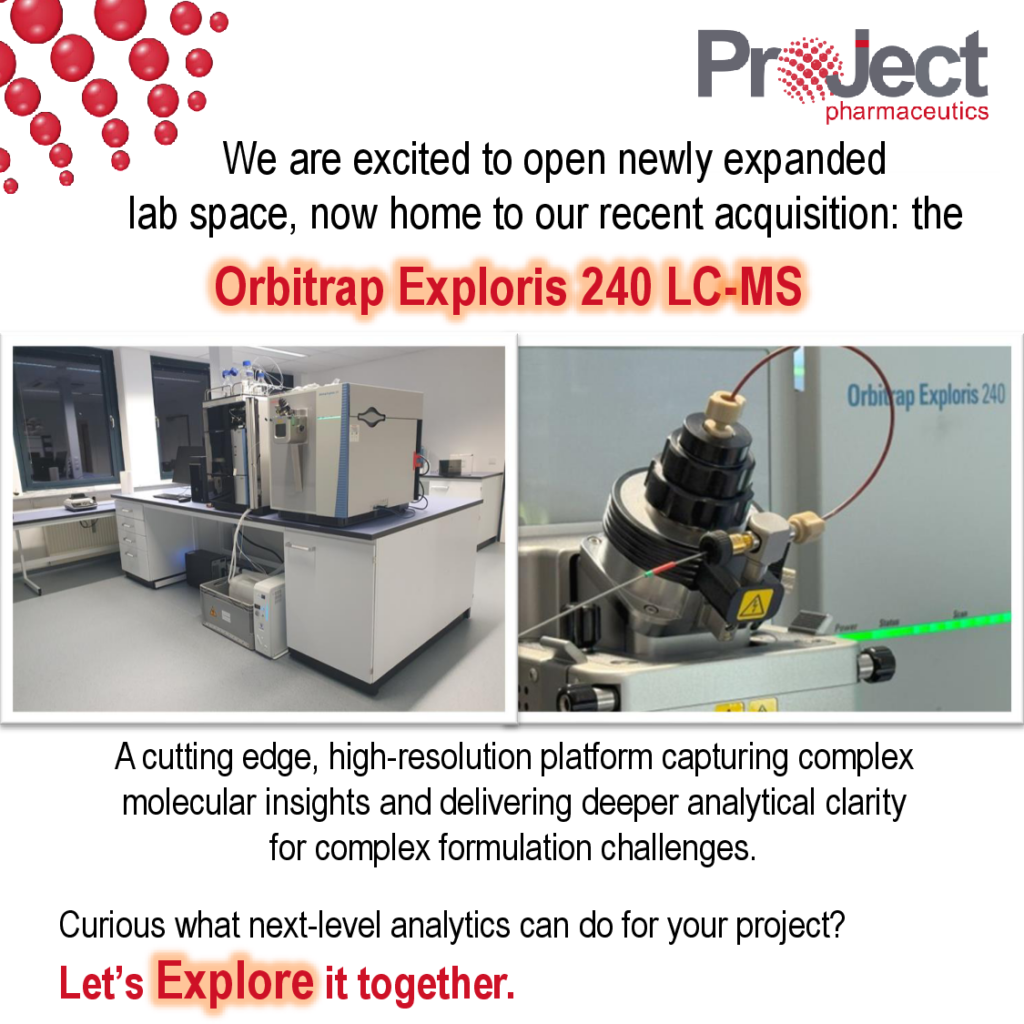
If so, we are prepared. We recently expanded our lab space, now home to our newest acquisition: the Orbitrap Exploris 240 LC-MS.

LCMS (Liquid Chromatography Mass Spectrometry) is rapidly emerging as a preferred technology for Multiple-Attribute Analysis (MAA), especially for complex biologics. By consolidating into a single, information-rich run what previously required multiple chromatographic methods (RP, IEX, HIC, etc.), LC-MS provides detailed molecular insights, enabling monitoring of critical quality attributes.
A trend today, a potential regulatory standard tomorrow? ProJect Pharmaceutics is already leading the way with next-generation technology on board!
ProJect Pharmaceutics is a CRO specialized in formulation and lyophilization process development for injectable drug products. Our newest team member, the Orbitrap Exploris 240 LC-MS (by Thermo Fisher https://documents.thermofisher.com/TFS-Assets/CMD/brochures/br-73410-ms-orbitrap-exploris-240-br73410-en.pdf), has moved into our expanded laboratory space, enabling next-level analytics for formulation and process development of injectable drug products, such as:

  • mAb and ADC characterization
  • Native DAR determination by SEC-MS
  • Drug-load-distribution by PepMap
  • Detection of degradation (fragments, side chain modifications, hydrolysis)
  • Analysis of mAb glycosylation
  • Impurity analysis (e.g. HCP)

Partner with us to unlock faster, deeper, and more precise analytical insights.

lc ms post white

Powering Next-Level Analytics: ProJect Pharmaceutics’s expanded lab welcomes the Orbitrap Exploris 240 LC-MS to elevate formulation science

ProJect Pharmaceutics is excited to open newly expanded lab space, now home to our most recent acquisition: the Orbitrap Exploris 240 LC-MS – a cutting edge, high-resolution platform capturing complex molecular insights and delivering deeper analytical clarity for complex formulation challenges. Curious what next-level analytics can do for your project?

The multi-attribute method (MAM), a liquid chromatography-mass spectrometry (LC-MS)-based peptide mapping method, has started to gain increased interest and applications in the biopharmaceutical industry. MAM can, by applying only one method, provide targeted quantitation of multiple site-specific product quality attributes, as well as new peak detection (Yang et al., Mass spectrometry-based multi-attribute method in protein therapeutics product quality monitoring and quality control, MABS 2023, Vol. 15, No. 1, 2197668). These days, LC-MS is rapidly emerging as a preferred technology for Multiple-Attribute Analysis (MAA), especially for complex biologics. By consolidating into a single, information-rich run what previously required multiple chromatographic methods (RP, IEX, HIC, R-CE-SDS, etc.), LC-MS provides detailed molecular insights, enabling monitoring of critical quality attributes of complex therapeutic proteins. Several literatures (i.a. Rathore et al., The role of mass spectrometry in the characterization of biologic protein products, Expert Rev Proteomics, 2018, 15(5), 431-49) have divided the role of MS in the characterization of biologics into the following main areas: product identity testing, characterization, comparability assessment, adulteration analysis, demonstration of critical quality attribute consistency during product development, and in PK/PD studies. A trend today, a potential regulatory standard for quality control (QC) testing tomorrow? ProJect Pharmaceutics is already leading the way with next-generation technology on board!

ProJect Pharmaceutics is a CRO specialized in formulation and lyophilization process development for injectable drug products. Our newest team member, the Orbitrap Exploris 240 LC-MS (by Thermo Fisher), has moved into our expanded laboratory space, enabling next-level analytics for formulation and process development of injectable drug products, such as:

  • mAb and ADC characterization
  • Native DAR determination by SEC-MS
  • Drug-load-distribution by PepMap
  • Detection of degradation (fragments, side chain modifications, hydrolysis)
  • Analysis of mAb glycosylation
  • Impurity analysis (e.g. HCP)

Partner with us to unlock faster, deeper, and more precise analytical insights.