Why is a strong ADC formulation development a make-or-break step in clinical success?

Antibody-drug conjugates (ADCs) are among the most promising modalities in oncology – but bringing them into the clinic isn’t straightforward. One of the most underestimated challenges? Formulation development.

ADCs combine three fragile components – an antibody, a linker, and a highly potent payload. Each can degrade in different ways, and if the formulation doesn’t control those risks, the entire program is at stake. What many don’t realize is that ADC CMC work is extremely expensive. Because of that, early-stage companies often aim to manufacture one GMP batch that can last through Phase I and even Phase II clinical trials. That strategy only works if the formulation is rock-solid.

A strong formulation must:

  • Maintain stability over multiple years
  • Prevent aggregation and linker/payload degradation
  • Protect DAR integrity
  • Enable consistent, safe handling at clinical sites

If the batch doesn’t hold up, teams face high costs, delays, comparability challenges – and sometimes program-ending setbacks. ADC formulation isn’t a “nice to have.” It’s one of the most critical investments you can make to protect your clinical timeline and budget.

At ProJect Pharmaceutics we are well aware of those challenges and develop ADC formulations tailored to each individual ADC molecule taking into account its intrinsic physicochemical properties in solution. One fits all and any platform formulation concepts disregard the “sweet spot” that each particular molecule intrinsically features when it comes to stability. However, formulating around the “sweet spot” by scientific understanding of the molecule’s physicochemical properties paves the way towards a strong ADC formulation and clinical success. ProJect Pharmaceutics has been developing ADC formulations since >15 years – 9% thereof are in phase III now, 18% in phase II, 14% in phase I/II, and 14% have completed phase I.

De-risk your ADC program with a best-in-class drug product formulation. Partner with us and let our experienced team safeguard your molecule’s clinical future.

chatgpt image 7. jan. 2026, 16 10 14 for amgen post

Is next level Multi-Attribute Analysis by LC-MS becoming the new regulatory standard?

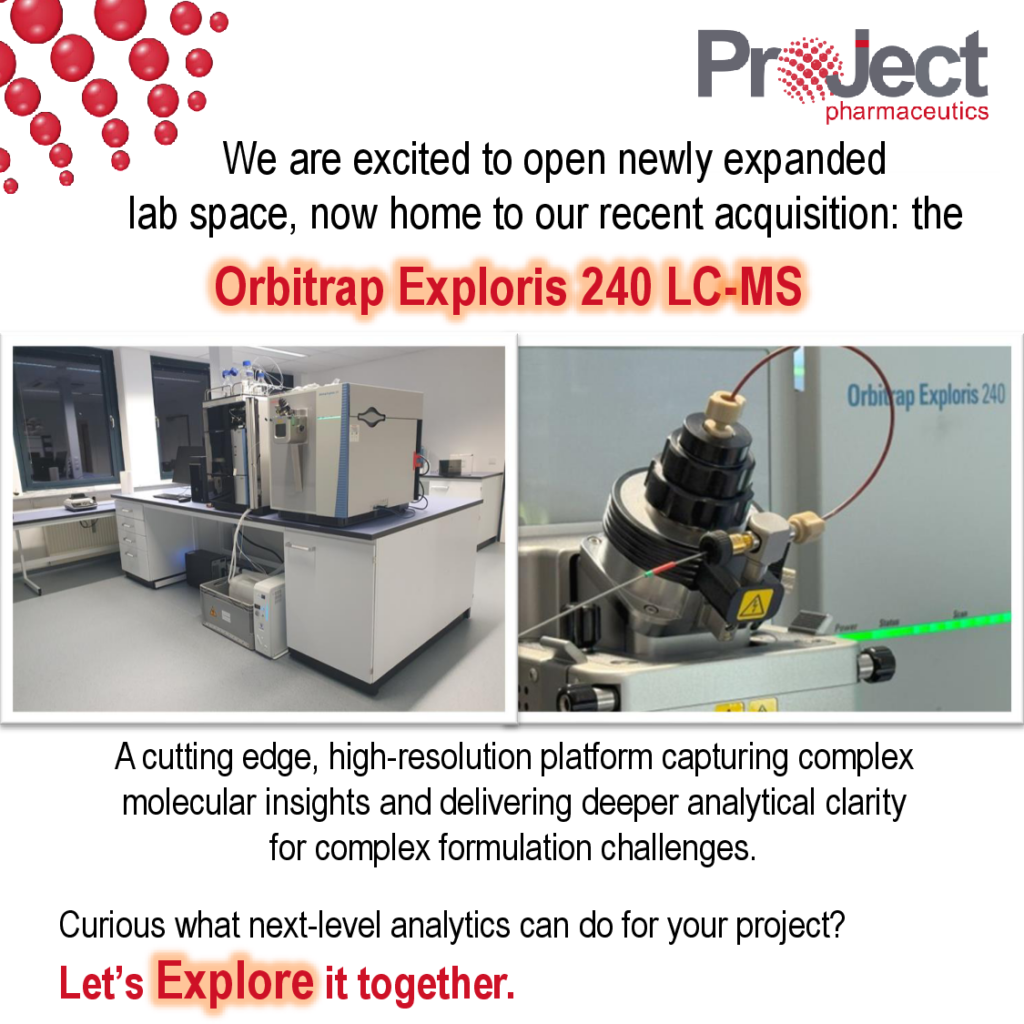
If so, we are prepared. We recently expanded our lab space, now home to our newest acquisition: the Orbitrap Exploris 240 LC-MS.

LCMS (Liquid Chromatography Mass Spectrometry) is rapidly emerging as a preferred technology for Multiple-Attribute Analysis (MAA), especially for complex biologics. By consolidating into a single, information-rich run what previously required multiple chromatographic methods (RP, IEX, HIC, etc.), LC-MS provides detailed molecular insights, enabling monitoring of critical quality attributes.
A trend today, a potential regulatory standard tomorrow? ProJect Pharmaceutics is already leading the way with next-generation technology on board!
ProJect Pharmaceutics is a CRO specialized in formulation and lyophilization process development for injectable drug products. Our newest team member, the Orbitrap Exploris 240 LC-MS (by Thermo Fisher https://documents.thermofisher.com/TFS-Assets/CMD/brochures/br-73410-ms-orbitrap-exploris-240-br73410-en.pdf), has moved into our expanded laboratory space, enabling next-level analytics for formulation and process development of injectable drug products, such as:

  • mAb and ADC characterization
  • Native DAR determination by SEC-MS
  • Drug-load-distribution by PepMap
  • Detection of degradation (fragments, side chain modifications, hydrolysis)
  • Analysis of mAb glycosylation
  • Impurity analysis (e.g. HCP)

Partner with us to unlock faster, deeper, and more precise analytical insights.

lc ms post white

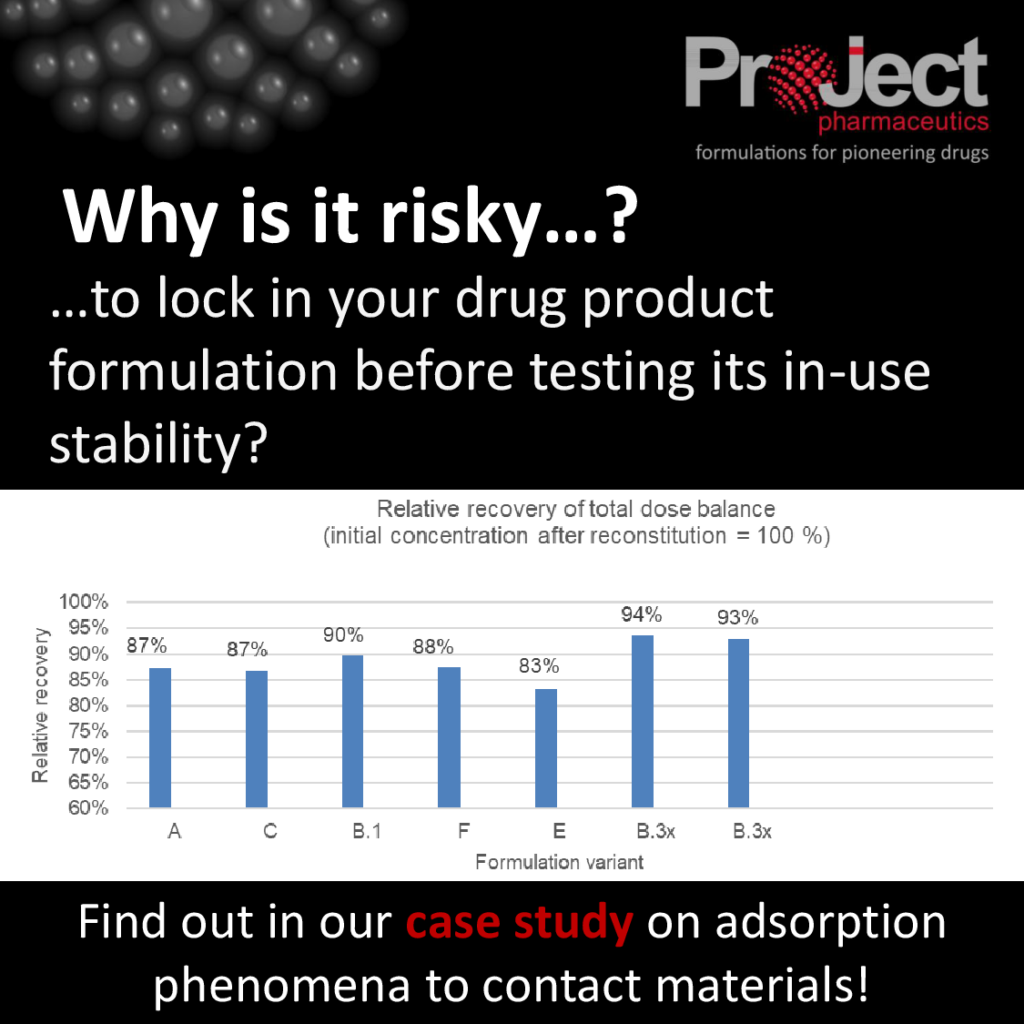
Why is it risky to lock in your drug product formulation before testing its in-use stability?

In-use stability studies are typically conducted in the later stages of drug development – once the DP formulation has been finalized and just before entering clinical trials and the regulatory approval phase.

However, this can be very risky as the recovery rates of infusion devices and the adsorption phenomena on contact materials (syringes, CSTDs, infusion lines, etc.) during use (“in-use”) are still unknown.

At ProJect Pharmaceutics we preventatively integrate in-use stability trials early informulation development, helping our customers make data driven decisions for their formulation lock.

We are pleased to present a confirming example in the following case study:

  • The 5 most promising formulation candidates were investigated in a simulated infusion procedure
  • A difference of up to 10 % recovery were observed between formulations
  • Formulation B.3x was able to significantly reduce the adsorption phenomena even further

The formulation composition of B.3x was derived by back-calculating data from in-use stability studies on B.1. It was then optimized to determine “how much content of a particular inactive ingredient is required to prevent the observed adsorption phenomena”. Our customer was thus in the lucky position to select their final formulation based on in-use stability data generated during drug product development, leading to a more robust and reliable drug product entering into clinical studies.

ProJect Pharmaceutics CRO is an independent, European development partner offering in-use stability studies for injectable drug products from early formulation development to late stages just ahead of clinical trials. We test the DP compatibility with i.e. common infusion media as well as infusion and injection equipment early during formulation development.

in use study case study 3x ps content

Did you know that in-use stability studies conducted earlier than shortly before clinical trials can protect you from unpleasant surprises?

Did you know that a drug candidate whose formulation development is supported by early in-use stability studies has a higher chance of making it through the clinic? Optimizing formulation and packaging to improve stability during use can lead to a higher-quality product. The early detection of in-use stability issues enables timely corrective action before the product is released for larger-scale clinical trials, reducing development costs.
ProJect Pharmaceutics CRO is an independent, European development partner offering in-use stability studies for injectable drug products from as early as alongside formulation development to as late as ahead of clinical trials. During formulation development we test early on i.e. compatibility with common infusion media as well as real-time stability of reconstituted lyophilization solution. We have the necessary laboratories, technical equipment, consumables and expertise to replicate the conditions for your clinical trial so that we can evaluate the stability of your drug in various formulations in real-life application scenarios, such as i.a.:

  • Compatibility with in-use consumables (CSTDs, syringes, IV bags, IV lines, etc.)
  • Storage stability (hold times)
  • Simulation of handling steps and administration procedure
  • Evaluation of adsorption phenomena and recovery from IV equipment
  • Dilution study for dose simulation
in use studies earlier than clinic

Looking for a development partner offering in-use stability studies for injectable drug products to enter clinical trials?

At ProJect Pharmaceutics CRO, we offer the expertise and flexibility to replicate your clinicaltrial conditions to evaluate the stability of your drug product during real application scenarios. Whether administered through bolus injection or infusion, we can replicate your specific procedures using the relevant materials and equipment (e.g. perfusor syringe pump, Closed System Drug-Transfer Device (CSTD), IV bag, IV line set, etc.). We also assist in identifying the most suitable filter units, tubing systems, and other necessary materials. Should any adsorption issues arise, we aid in identifying the most appropriate stabilizing agents at optimal concentration to align seamlessly with your DP formulation and manufacturing processes (i.e. lyophilization).
We conduct in-use stability studies for all classes of molecules for which we also offer formulation development and process development, i.e. biologics, ADCs, cytotoxic drugs, small molecules, and peptides. Our in-use safety laboratory is equipped with infusion stands for infusion via gravity and with perfusor pumps. We also operate a red-light laboratory for handling light-sensitive substances.

in ue study redlight lab

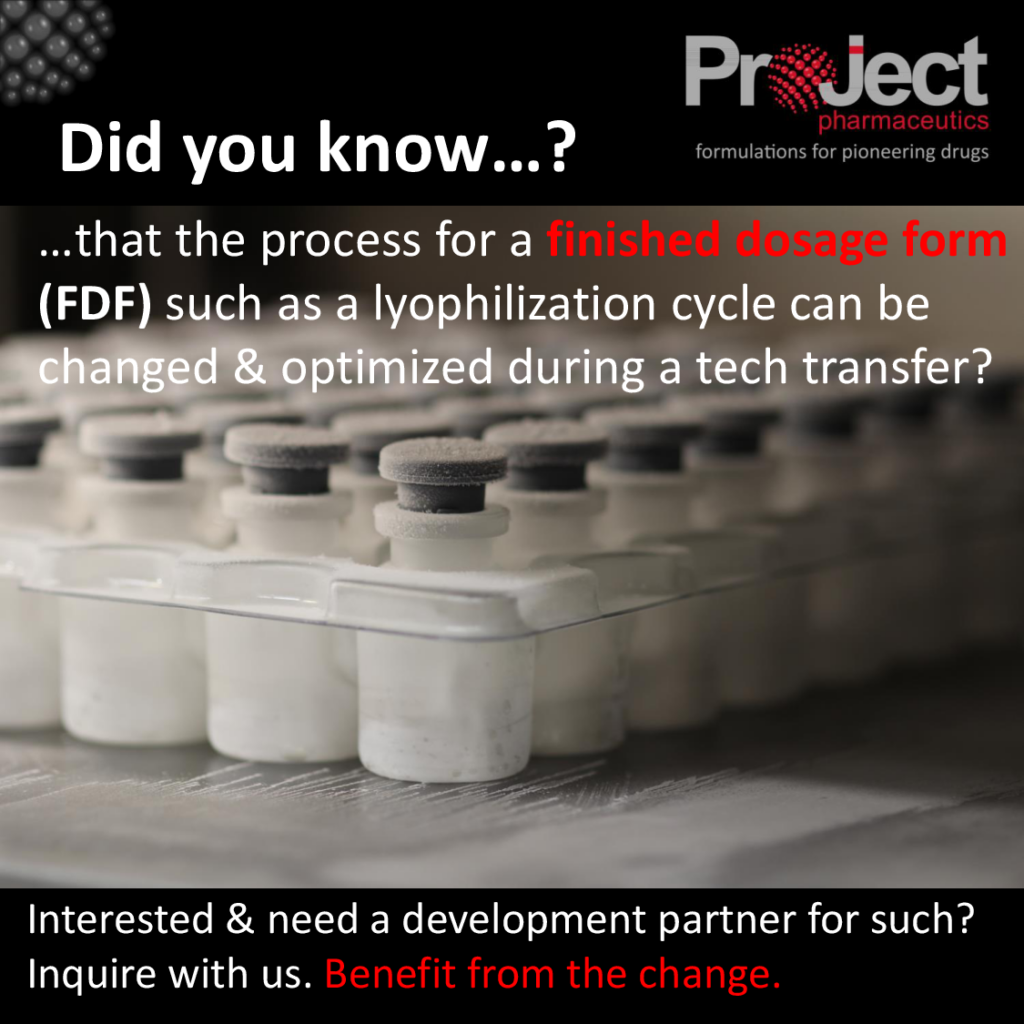
Did you know that the process for a finished dosage form (FDF) such as a lyophilization cycle can be changed & optimized during a tech transfer?

Changing and optimizing a process such as a freeze drying cycle during a technology transfer for finished dosage forms (FDF) can not only improve efficiency, reduce costs, enhance product quality but can often also profit from innovations and advanced technologies that the new site has to offer. Furthermore, there are new possibilities to adapt the lyophilization cycle to the new plant and to obtain a production slot more easily with a modern, efficient (cost and time-saving) lyophilization cycle that is optimally adapted to the product thanks to new technologies.
At ProJect Pharmaceutics CRO we are experts in lyophilization process development for injectable drug products and have installed advanced lyophilization technologies on site. By means of a very systematic (algorithm-based) approach we explore very quickly in up to five (!) lyophilization cycles max. the ideal freezing, sublimation and drying parameters. Challenging the final cycle program in a process robustness testing panel will evaluate the design space of the critical process parameters. Cycles optimized this way in terms of robustness and efficiency enable a very smooth tech transfer: with a validated design space and a robustly tested lyophilization cycle, the number of engineering batches needed during technology transfer can potentially be reduced.
If you would like to benefit fully from the switch to a new production site with an optimized, modern lyophilization cycle, please contact us

fdf process optimization for tech transfer

How to determine the optimal secondary drying time during lyophilization?

Determining the optimal secondary drying time in a lyophilization (freeze drying) cycle for drug products is critical for several reasons related to product quality, stability, and manufacturing efficiency:

  • Controlling residual moisture content to enhance product stability and shelf life
  • Minimizing process time and cost to improve manufacturing efficiency
  • Preventing over-drying to avoid fragility of the lyophilized cake, or loss of potency, and to improve ease of reconstitution and overall appearance

Optimizing the secondary drying time during drug development is essential to balance quality, cost, and efficiency while ensuring compliance with regulatory standards and delivering a stable, effective drug product.
At ProJect Pharmaceutics CRO we are experts in lyophilization process development for injectable drug products. We have developed a smart approach to determine the required secondary drying time to achieve the target residual moisture content within a single (!) lyophilization cycle. By sampling sub-lots of vials closed at different time points during secondary drying, we can analyze up to ten (!) different, freely programmable timepoints during ongoing secondary drying.
If you would like to benefit from a secondary drying time that is optimally tailored to your product, please contact us.

secondary drying time determination

Is controlled nucleation the right choice for your drug product?

In some cases, controlled nucleation (CN) significantly improves the quality of lyophilized products. In other cases, it is just a waste of time.
How to find out, quickly and reliably?
Experience the difference – complex science, made simple: We at ProJect Pharmaceutics are experts in freeze drying technology and a trusted CRO partner for lyophilization cycle development and optimization. Using high-end lyophilization technologies, we can help you test whether controlled nucleation is the right choice for your drug product. With our innovative method, we can specifically trigger controlled nucleation in individual vials, enabling a head-to-head comparison of controlled nucleation vs. standard freezing within the same lyophilization run.
Experience controlled nucleation – without the full package commitment: With just one feasibility cycle, we will simulate controlled nucleation in individual vials, allowing you to compare results directly. Our advanced macro-video system captures every detail, giving you a clear view of your drug product’s performance – right before your eyes.
ProJect Pharmaceutics – maximizing results with advanced lyophilization: experience the difference and find out if controlled nucleation is also beneficial for YOUR drug product.

Check out our video on controlled nucleation on our YouTube channel https://www.youtube.com/watch?v=oUhS6bDrlCY

How to avoid vial breakage in lyophilization?

Vial breakage is a serious problem in the sterile production of a lyophilized pharmaceutical. In addition to product loss, the contamination of the freeze dryer with product residues and glass fragments poses a high risk and requires considerable cleaning effort. Vial breakage is often caused by factors like thermal and mechanical stress, crystallization of formulation components, inadequate primary packaging, improperly designed process parameters, or combination of those. Understanding these factors is key to optimizing your freeze drying process and ensuring product quality and cost effectiveness.
At ProJect Pharmaceutics, we are experts in freeze drying technology and your trusted CRO partner for lyophilization cycle development and optimization. Using high-end lyophilization technologies, we swiftly identify and address the root causes of vial breakage. Through our advanced macro-video system we perform a root-cause analysis, monitoring the entire cycle to pinpoint critical parameters that lead to product defects. Based on our findings, we develop effective avoidance strategies and provide tailored solutions to optimize your product’s process and quality.

Check out our video on vial breakage on our YouTube channel https://www.youtube.com/watch?v=sP-1X2_yC7U

How to accelerate and build quality into the formulation development process of complex modalities like ADCs?

Transform your delicate ADC molecule into a stable quality product with our expert CRO formulation services!
ProJect Pharmaceutics is a CRO specialized in formulation and lyophilization process development for antibody-drug conjugates. We have been developing ADCs in our dedicated safety laboratories for > 15 years and have seen all generations of ADCs on our workbench. By combining protein formulation and process know-how with cytotoxic drug expertise the company holds unique assets to develop ADC drug products. By means of modern and advanced screening technologies we accelerate formulation development and target a formulation that suits antibody, linker and payload to stabilize the ADC at its “sweet spot”.

adc slider ii new pictures 002
adc slider ii new pictures 003
adc slider ii new pictures 004
adc slider ii new pictures 005
adc slider ii new pictures 006
adc slider ii new pictures 007
adc slider ii new pictures 008